

Manual entry, on purpose
Hold your spending accountable. Type it in.
Budgetpoint has no bank sync because the typing is the point. You record each purchase yourself, and the Spending Dial keeps your eye on your impulse category with ease, in a budget that runs payday to payday.
No credit card required. No bank to connect.
See screenshots below
Tracked, or typed
Stop reviewing your spending. Start deciding it.
| Bank sync | Budgetpoint | |
|---|---|---|
| When you find out | Days later, when the bank posts it | The moment you type it |
| Your part | Approve what already happened | Decide while it is happening |
| How it feels | Guilt at the end of the week | Awareness before the card is swiped |
| What it needs | Your bank login, held by someone else | Nothing connected |
A list you review at the end of the week is a report. A purchase you type as you make it is a decision.
The power of manual entry
If you didn’t type it, you didn’t notice it.
Automatic imports are how spending goes out of sight and out of mind: it lands in a list you were not looking at. Typing it puts it back in front of you.
- You find out now, not at the end of the week. The purchase and the record happen together, so the number you are looking at is today’s.
- Nothing lands unseen. Every row in your register is there because you put it there. A purchase cannot slip past you when you are the only way in.
- The pause is the point. The moment it takes to type a purchase is the moment you get to reconsider it. That small friction is a feature, not a flaw.
Privacy
Zero bank sync. Zero trackers. Zero data brokers.
Your household’s books are yours and stay that way. No bank connections, no third-party trackers, and no data brokers between you and your numbers.
You type your transactions, so there is no bank connection and no third party holding your credentials. No tracking cookies, no ad networks, nothing following you off this page. We do not build a picture of you, and we do not sell one.
There is no free tier, because there is no other way this is paid for. Your subscription is the whole business model.
The proof underneath
Payday timing. Ledger accuracy.
A paycheck-period budget is only useful if the numbers can be trusted. The register is where that trust lives: one row per transaction, a balance that reads straight down the page, and whole cents from entry to storage.
Tab across a row, type ahead on payees and categories, and create either one as you go. You never have to leave the register to set something up first.
- Manual entry. You type each transaction yourself, with no bank connection between you and your books.
- Transfers. Move money between two of your own accounts and both sides stay honest.
- Nested categories. Type Food: Groceries and the hierarchy is made for you.
- Your own order. Drag same-day rows so the running balance reads the way the day actually went.


The Spending Dial
Slow the impulse.
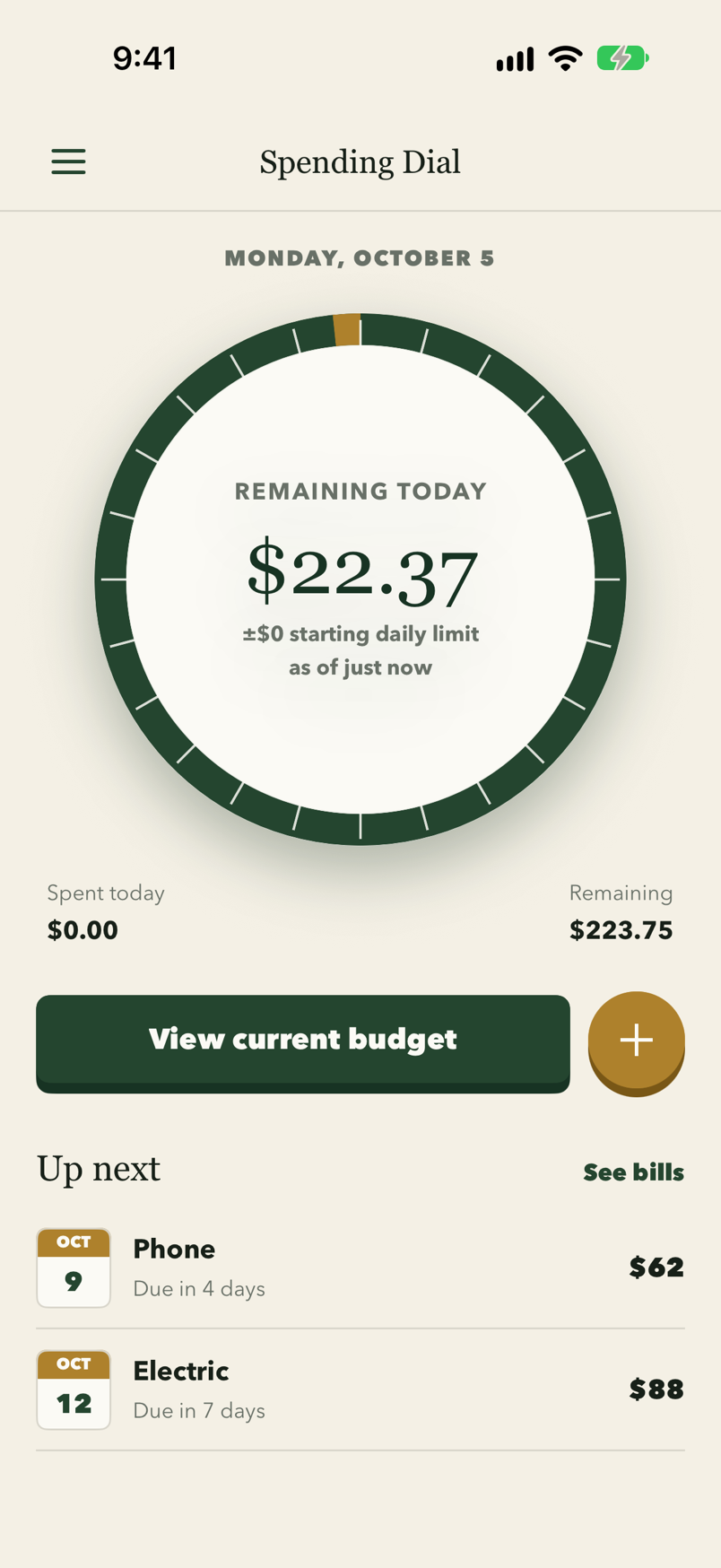
Keep your eye on the danger zone. You already know which category gets you, so point your Spending Dial at it.
Every purchase you type in moves the dial. One look tells you how much room is left before an impulse buy blows this paycheck, while there is still time to step back.
Manual entry holds you accountable. The dial keeps your eye on it with ease.
- Your category. Aim the dial at the spending you least trust yourself with.
- Moves as you type. Record a purchase and the dial moves with it.
- Before, not after. You see your room before you swipe, not at the end of the week.
Budget periods
Which rhythm matches your income?
Your budget can follow the dates your household actually gets paid instead of pretending every paycheck arrives on the first.


The forecast
See the dip before you are standing in it
The forecast projects your balances forward from the recurring transactions and scheduled bills you have already entered. The insurance renewal, the quarterly water bill, the thing that lands on the fourteenth every month.
You get to look at the low point three weeks out while there is still time to move something. It is a much better conversation to have on a Sunday than on the day the payment bounces.


One household, one live plan
The paycheck has one plan. Everyone sees it.
One of you should not have to translate the budget for the other. When the pay period changes, everyone in the household sees the same categories, allocations, activity and available amounts.
The household owns the accounts, transactions and budget. Send an invite link and the other person joins the same books with the same access — no viewer role, no second copy and nothing to keep in sync.
| What it covers | The person who set it up | The person they invited |
|---|---|---|
| The current budget period | Full | Full |
| Every account and balance | Full | Full |
| Every transaction, past and new | Full | Full |
| Categories and allocations | Full | Full |
| Forecast and reports | Full | Full |
| Inviting the next person | Full | Full |
Same payday. Same budget period. Same numbers. Both people can make the next decision from the same place.


Start on the next payday
Hold yourself to it, starting this payday.
Create your register, pick the category you want to keep your eye on, and type the first purchase in.